M.E Manufacturing Engineering
Programme Educational Objectives (PEO’s)
- To prepare students to know and utilize the modern manufacturing facility in order to improve productivity.
- To impart skills to use smart machines and apply latest technology in manufacturing field to innovate production process that will be useful to the Society
- To imbibe skills for integrated problem-solving techniques to optimize the Manufacturing resources for sustainable development
- To develop research attitude, new product, and process to solve problems in the field of manufacturing and to prepare the necessary reports.
Program Outcomes (PO’s)
1. An ability to independently carry out research/investigation and development work to solve practical problems.
2. An ability to write and present a substantial technical report/document.
3. Students should be able to demonstrate a degree of mastery over the area as per the specialization of the program. The mastery should be at a level higher than the requirements in the appropriate bachelor program.
4. An ability to design systems, components, or processes meeting specified needs for the manufacturing industry and to improve its efficiency.
5. To use modern equipment and problem-solving tools for improving the manufacturing systems and processes in all aspects including technical, financial and management
6. To pursue higher studies / pursue their career or entrepreneur in manufacturing and allied industries
| MA4155- APPLIED PROBABILITY AND STATISTICS FOR MANUFACTURING ENGINEERING – [C101] | ||
| C101.1 | Analyze the performance in terms of probabilities and distributions achieved by the determined solutions. | |
| C101.2 | Be familiar with some of the commonly encountered two dimensional random variables and be equipped for a possible extension to multivariate analysis. | |
| C101.3 | Apply the basic principles underlying statistical inference(hypothesis testing). | |
| C101.4 | Demonstrate knowledge of applicable large sample theory of estimators and tests. | |
| C101.5 | Obtain a better understanding of the importance of the methods in modern industrial processes. | |
| MF4101 – ADVANCES IN MANUFACTURING PROCESS – [C102] | ||
| C102.1 | Analyze the processes and evaluate the role of each process parameter during machining of various advanced materials. | |
| C102.2 | Understand requirements to achieve maximum material removal rate and best quality of machined surface while machining various industrial engineering materials. | |
| C102.3 | Analyze the different bulk metal forming process mechanics using different analysis | |
| C102.4 | Acquire the knowledge in mechanical micromachining processes. | |
| C102.5 | Demonstrate the knowledge of Additive Manufacturing and Rapid Prototyping Technologies | |
| CM5102 – COMPUTER AIDED MANUFACTURING – [C103] | ||
| C103.1 | Recognize the importance of CAD, CAM, CIM, Engineering product specification and interpreting geometric specifications. | |
| C103.2 | Improve knowledge on the integration of CAD and CAM. | |
| C103.3 | Exhibit competency in manual part program and generation of CNC part program using CAM packages. | |
| C103.4 | Describe the implementation of CAD and CAM in manufacturing processes. | |
| C103.5 | Explain applications of IOT in computer aided manufacturing. | |
| MF4102- ADVANCES IN CASTING AND WELDING – [C104] | ||
| C104.1 | At the end of this course the students are expected to impart knowledge on basic concepts and advances in casting and welding processes. | |
| C104.2 | Know and perform solid state and special welding processes. | |
| C104.3 | Understand and analyze the material structures after welding. | |
| C104.4 | Design the weldments for various materials. | |
| C104.5 | Attain the knowledge about various welding defects and inspection methods. | |
| MF4103 – THEORY OF METAL CUTTING – [C105] | ||
| C105.1 | Basics of orthogonal cutting, oblique cutting and chip formation | |
| C105.2 | Different tool materials, tool life and tool wear mechanisms | |
| C105.3 | Necessity for a cutting fluid and cutting efficiency | |
| C105.4 | Single and Multipoint cutting tools | |
| C105.5 | Effect of vibrations and surface roughness during machining | |
| MF4111 – CAD/CAM LABORATORY – [C106] | ||
| C106.1 | Interpret mechanical drawings for components, assemblies and use parametric 3D CAD software tools in the correct manner for creating their geometric part models, assemblies and automated drawings. | |
| C106.2 | Apply the concepts of machining for the purpose of selection of appropriate machining centres, machining parameters, select appropriate cutting tools for CNC milling and turning equipment, set-up, program, and operate CNC milling and turning equipment. | |
| C106.3 | Create and validate NC part program data using manual data input (MDI) and automatically using standard commercial CAM package for manufacturing of required component using CNC milling or turning applications. | |
| C106.4 | Produce an industrial component by interpreting 3D part model/ part drawings using Computer Aided Manufacturing technology through programming, setup, and ensuring safe operation of Computer Numerical Control (CNC) machine tools. | |
| C106.5 | Create and demonstrate the technical documentation for design/ selection of suitable drive technologies, precision components and an overall CNC machine tool system for automation of machining operations appropriate multi-axis CNC technology.using | |
| MF4112 – TECHNICAL SEMINAR – [C107] | ||
| C107.1 | To develop skills to search, read, write, comprehend and present research papers in the areas of manufacturing engineering. | |
| C107.2 | Updated with the latest technology in the field of Manufacturing Engineering | |
| C107.3 | Able to plot graph, sketch, bring out the visual about his understanding on various topics | |
| MF4201 – OPTIMIZATION TECHNIQUES IN MANUFACTURING – [C108] | ||
| C108.1 | At the end of this course the students will be expected to introduce the various optimization techniques and their advancements. | |
| C108.2 | Ability to go in research by applying optimization techniques in problems of Engineering and Technology | |
| C108.3 | Use classical optimization techniques and numerical methods of optimization. | |
| C108.4 | Describe the basics of different evolutionary algorithms | |
| C108.5 | Ability to solve the mathematical results and numerical techniques of optimization theory to concrete Engineering problems by using computer software | |
| MF4202 – ADVANCES IN METROLOGY AND INSPECTION – [C109] | ||
| C109.1 | Understand the advanced measurement principles with ease. | |
| C109.2 | Operate sophisticated and accurate measuring instruments. | |
| C109.3 | Understand the various inspection methods and tools | |
| C109.4 | Design and develop new measuring methods. | |
| C109.5 | Apply computers in Measurement | |
| MF4203 – THEORY OF METAL FORMING – [C110] | ||
| C110.1 | At the end of this course the students are expected to upgrade their knowledge on various metal forming techniques and formability | |
| C110.2 | Apply the theory of plasticity for various types of metal forming process. | |
| C110.3 | Apply the concept of powder metallurgy to make prismatic components | |
| C110.4 | Understand Non-traditional forming processes. | |
| C110.5 | Understand the purpose of surface treatment in metal forming applications | |
| MF4204 – ADDITIVE MANUFACTURING – [C111 | ||
| C111.1 | The students are expected to learn about a variety of Additive Manufacturing (AM) technologies. | |
| C111.2 | Describe additive manufacturing and explain its advantages and disadvantages | |
| C111.3 | Explain the processes used in additive manufacturing for a range of materials and applications | |
| C111.4 | understand the role of additive manufacturing in the design process and their potential to support Design and manufacturing, | |
| C111.5 | Case studies relevant to mass customized manufacturing, and some of the important research challenges associated with AM and its data processing tools | |
| MF4205 – FLUID POWER AUTOMATION – [C112] | ||
| C112.1 | At the end of this course the students are familiarized in the area of hydraulics, pneumatic and fluid power components and its functions. | |
| C112.2 | Recognize the standard symbols used in fluid power circuits and assess the suitable component for a particular application | |
| C112.3 | Construct the hydraulic circuits for an industrial application. | |
| C112.4 | Build a pneumatic circuit and apply them to real life problems. | |
| C112.5 | Design and develop a PLC controlled pneumatic circuit for industrial application | |
| MF4001 – MICRO MANUFACTURING – [C113] | ||
| C113.1 | To impart the principles of various basic micro manufacturing process | |
| C113.2 | To know and perform micro machining | |
| C113.3 | Research various micro machining process to optimize the process variables | |
| C113.4 | Attain knowledge about polishing techniques | |
| C113.5 | Measure and analyse the various parameters of micro machined components | |
| MF4007 –LEAN MANUFACTURING – [C114] | ||
| C114.1 | To know the necessity for a Lean Manufacturing system | |
| C114.2 | To Differentiate between the conventional Mass production system with Lean system | |
| C114.3 | In effectively implement the principles of JIT | |
| C114.4 | To apply the Inspection tools effectively in the Lean systems | |
| C114.5 | To apply Hoshin planning system to create a Lean culture in Industry | |
| MF4211 -AUTOMATION AND METAL FORMING LAB [C115] | ||
| C115.1 | To impart practical knowledge on bulk metal forming processes | |
| C115.2 | Know various symbols used in Hydraulic and Pneumatic circuits | |
| C115.3 | Conduct few sheet metals forming processes and analyse the parameters | |
| C115.4 | Design hydraulic circuits for industrial applications | |
| C115.5 | Learnt how to use automation studio | |
| MF4212 – ADVANCED MANUFACTURING PROCESS LAB – [C116] | ||
| C116.1 | Determination of maximum and minimum position of links. | |
| C116.2 | Verification of transformation (Position and orientation) with respect to gripper and world coordinate system | |
| C116.3 | Estimation of accuracy, repeatability and resolution. | |
| C116.4 | Robot programming and simulation for pick and place | |
| C116.5 | Robot programming and simulation for Color identification | |
| C116.6 | Robot programming and simulation for Shape identification | |
| PD4391 – PRODUCT LIFE CYCLE MANAGEMENT – [C201] |
||
| C201.1 | Summarize the history, concepts and terminology of PLM | |
| C201.2 | Use the functions and features of PLM/PDM | |
| C201.3 | Use different modules offered in commercial PLM/PDM tools. | |
| C201.4 | Implement PLM/PDM approaches for industrial applications. | |
| C201.5 | Integrate PLM/PDM with legacy data bases, CAx& ERP systems | |
| MF4015 – PRODUCT DESIGN AND DEVELOPMENT – [C202] |
||
| C202.1 | Identify the need for a New Product | |
| C202.2 | design and develop various products | |
| C202.3 | Work out the cost of developing a product | |
| C202.4 | Will be able to prototype the product | |
| C202.5 | Know how to patent the new design or the product | |
| MF4016 – ENTRPRENEURSHIP DEVELOPMENT – [C203] |
||
| C203.1 | Gain knowledge and skills needed to run a business. | |
| C203.2 | Innovate and solve challenges in business | |
| C203.3 | Determine risks in the trade and respond effectively | |
| C203.4 | Utilize tools and develop strategies to manage business | |
| C203.5 | Establish start-ups and Evaluate the business | |
| OBA434 – ETHICAL MANAGEMENT – [C204] |
||
| C204.1 | Role modelling and influencing the ethical and cultural context. | |
| C204.2 | Respond to ethical crises and proactively address potential crises situations. | |
| C204.3 | Understand and implement stakeholder management decisions. | |
| C204.4 | Develop the ability, knowledge, and skills for ethical management. | |
| C204.5 | Develop practical skills to navigate, resolve and thrive in management situations | |
| MF4311 -PROJECT WORK I – [C205] | ||
| C205.1 | Design and analyze, an identified problem using scientific tools | |
| C205.2 | Simulation/ Theoretical analysis of a physical system | |
| C205.3 | Integrate various domain knowledge for a sustainable solution. | |
| C205.4 | Set Goals, Targets, timeline, plan and execute activities of the project | |
| C205.5 | Disseminate work both in oral and written format. | |
| MF4411 – PROJECT WORK II – [C206] | ||
| C206.1 | Design and analyze, an identified problem using scientific tools and research | |
| C206.2 | Simulation/ Theoretical analysis of a physical system | |
| C206.3 | Integrate various domain knowledge in carrying out experimental work and provide a sustainable solution | |
| C206.4 | Set Goals, Targets, timeline, plan and execute activities of the project | |
| C206.5 | Disseminate work both in oral and written format. | |

Dr. P.L.Ramesh Kumar
M.E., Ph.d., MISTE., HOD / Professor
Manufacturing Engineering is a multidisciplinary field that integrates engineering science, materials, design, production technology, automation, and management principles to develop efficient and sustainable manufacturing systems. The field focuses on transforming raw materials into high-quality products through advanced manufacturing processes and technologies.
The Department of Mechanical Engineering offers M.E. Manufacturing Engineering, providing students with advanced knowledge and practical expertise in modern manufacturing technologies. The programme is designed to develop professionals capable of addressing contemporary challenges in manufacturing industries through innovative engineering solutions.
Dr. P.L.Ramesh Kumar
M.E., Ph.d., MISTE., HOD / Professor

Mr. J. Jebaraj M.E.,
Assistant Professor
2016 – 2025

Mr.T.Ragujohn M.E.,
Assistant Professor

Mr. A.Vadivel M.E.,
Assistant Professor
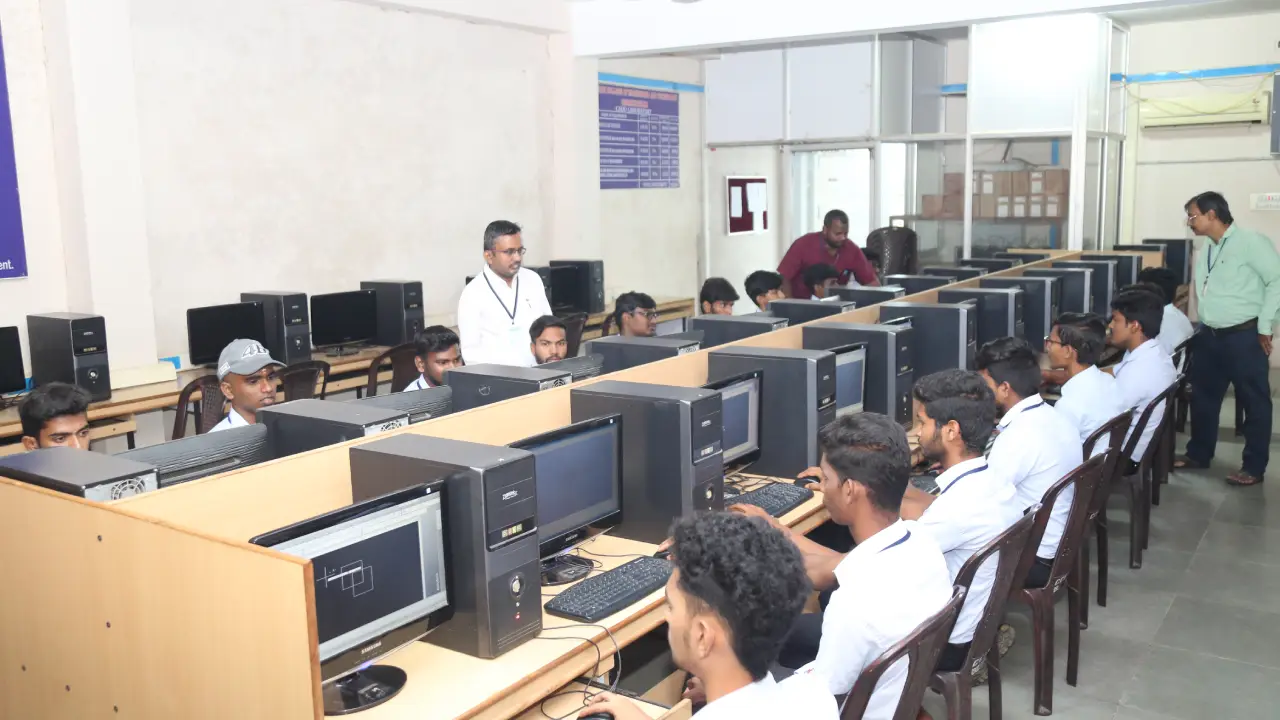
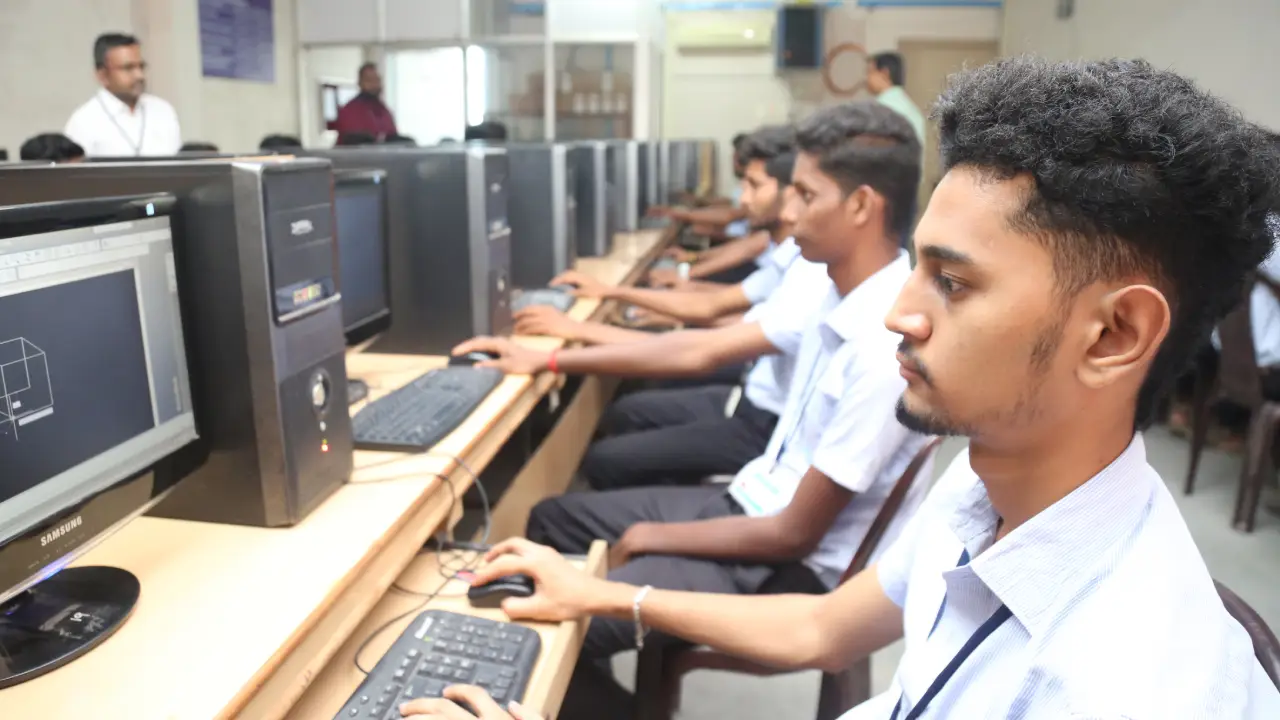
CAD / CAM Laboratory
Programme Educational Objectives (PEO’s)
- To prepare students to know and utilize the modern manufacturing facility in order to improve productivity.
- To impart skills to use smart machines and apply latest technology in manufacturing field to innovate production process that will be useful to the Society
- To imbibe skills for integrated problem-solving techniques to optimize the Manufacturing resources for sustainable development
- To develop research attitude, new product, and process to solve problems in the field of manufacturing and to prepare the necessary reports.
Program Outcomes (PO’s)
1. An ability to independently carry out research/investigation and development work to solve practical problems.
2. An ability to write and present a substantial technical report/document.
3. Students should be able to demonstrate a degree of mastery over the area as per the specialization of the program. The mastery should be at a level higher than the requirements in the appropriate bachelor program.
4. An ability to design systems, components, or processes meeting specified needs for the manufacturing industry and to improve its efficiency.
5. To use modern equipment and problem-solving tools for improving the manufacturing systems and processes in all aspects including technical, financial and management
6. To pursue higher studies / pursue their career or entrepreneur in manufacturing and allied industries
| MA4155- APPLIED PROBABILITY AND STATISTICS FOR MANUFACTURING ENGINEERING – [C101] | ||
| C101.1 | Analyze the performance in terms of probabilities and distributions achieved by the determined solutions. | |
| C101.2 | Be familiar with some of the commonly encountered two dimensional random variables and be equipped for a possible extension to multivariate analysis. | |
| C101.3 | Apply the basic principles underlying statistical inference(hypothesis testing). | |
| C101.4 | Demonstrate knowledge of applicable large sample theory of estimators and tests. | |
| C101.5 | Obtain a better understanding of the importance of the methods in modern industrial processes. | |
| MF4101 – ADVANCES IN MANUFACTURING PROCESS – [C102] | ||
| C102.1 | Analyze the processes and evaluate the role of each process parameter during machining of various advanced materials. | |
| C102.2 | Understand requirements to achieve maximum material removal rate and best quality of machined surface while machining various industrial engineering materials. | |
| C102.3 | Analyze the different bulk metal forming process mechanics using different analysis | |
| C102.4 | Acquire the knowledge in mechanical micromachining processes. | |
| C102.5 | Demonstrate the knowledge of Additive Manufacturing and Rapid Prototyping Technologies | |
| CM5102 – COMPUTER AIDED MANUFACTURING – [C103] | ||
| C103.1 | Recognize the importance of CAD, CAM, CIM, Engineering product specification and interpreting geometric specifications. | |
| C103.2 | Improve knowledge on the integration of CAD and CAM. | |
| C103.3 | Exhibit competency in manual part program and generation of CNC part program using CAM packages. | |
| C103.4 | Describe the implementation of CAD and CAM in manufacturing processes. | |
| C103.5 | Explain applications of IOT in computer aided manufacturing. | |
| MF4102- ADVANCES IN CASTING AND WELDING – [C104] | ||
| C104.1 | At the end of this course the students are expected to impart knowledge on basic concepts and advances in casting and welding processes. | |
| C104.2 | Know and perform solid state and special welding processes. | |
| C104.3 | Understand and analyze the material structures after welding. | |
| C104.4 | Design the weldments for various materials. | |
| C104.5 | Attain the knowledge about various welding defects and inspection methods. | |
| MF4103 – THEORY OF METAL CUTTING – [C105] | ||
| C105.1 | Basics of orthogonal cutting, oblique cutting and chip formation | |
| C105.2 | Different tool materials, tool life and tool wear mechanisms | |
| C105.3 | Necessity for a cutting fluid and cutting efficiency | |
| C105.4 | Single and Multipoint cutting tools | |
| C105.5 | Effect of vibrations and surface roughness during machining | |
| MF4111 – CAD/CAM LABORATORY – [C106] | ||
| C106.1 | Interpret mechanical drawings for components, assemblies and use parametric 3D CAD software tools in the correct manner for creating their geometric part models, assemblies and automated drawings. | |
| C106.2 | Apply the concepts of machining for the purpose of selection of appropriate machining centres, machining parameters, select appropriate cutting tools for CNC milling and turning equipment, set-up, program, and operate CNC milling and turning equipment. | |
| C106.3 | Create and validate NC part program data using manual data input (MDI) and automatically using standard commercial CAM package for manufacturing of required component using CNC milling or turning applications. | |
| C106.4 | Produce an industrial component by interpreting 3D part model/ part drawings using Computer Aided Manufacturing technology through programming, setup, and ensuring safe operation of Computer Numerical Control (CNC) machine tools. | |
| C106.5 | Create and demonstrate the technical documentation for design/ selection of suitable drive technologies, precision components and an overall CNC machine tool system for automation of machining operations appropriate multi-axis CNC technology.using | |
| MF4112 – TECHNICAL SEMINAR – [C107] | ||
| C107.1 | To develop skills to search, read, write, comprehend and present research papers in the areas of manufacturing engineering. | |
| C107.2 | Updated with the latest technology in the field of Manufacturing Engineering | |
| C107.3 | Able to plot graph, sketch, bring out the visual about his understanding on various topics | |
| MF4201 – OPTIMIZATION TECHNIQUES IN MANUFACTURING – [C108] | ||
| C108.1 | At the end of this course the students will be expected to introduce the various optimization techniques and their advancements. | |
| C108.2 | Ability to go in research by applying optimization techniques in problems of Engineering and Technology | |
| C108.3 | Use classical optimization techniques and numerical methods of optimization. | |
| C108.4 | Describe the basics of different evolutionary algorithms | |
| C108.5 | Ability to solve the mathematical results and numerical techniques of optimization theory to concrete Engineering problems by using computer software | |
| MF4202 – ADVANCES IN METROLOGY AND INSPECTION – [C109] | ||
| C109.1 | Understand the advanced measurement principles with ease. | |
| C109.2 | Operate sophisticated and accurate measuring instruments. | |
| C109.3 | Understand the various inspection methods and tools | |
| C109.4 | Design and develop new measuring methods. | |
| C109.5 | Apply computers in Measurement | |
| MF4203 – THEORY OF METAL FORMING – [C110] | ||
| C110.1 | At the end of this course the students are expected to upgrade their knowledge on various metal forming techniques and formability | |
| C110.2 | Apply the theory of plasticity for various types of metal forming process. | |
| C110.3 | Apply the concept of powder metallurgy to make prismatic components | |
| C110.4 | Understand Non-traditional forming processes. | |
| C110.5 | Understand the purpose of surface treatment in metal forming applications | |
| MF4204 – ADDITIVE MANUFACTURING – [C111 | ||
| C111.1 | The students are expected to learn about a variety of Additive Manufacturing (AM) technologies. | |
| C111.2 | Describe additive manufacturing and explain its advantages and disadvantages | |
| C111.3 | Explain the processes used in additive manufacturing for a range of materials and applications | |
| C111.4 | understand the role of additive manufacturing in the design process and their potential to support Design and manufacturing, | |
| C111.5 | Case studies relevant to mass customized manufacturing, and some of the important research challenges associated with AM and its data processing tools | |
| MF4205 – FLUID POWER AUTOMATION – [C112] | ||
| C112.1 | At the end of this course the students are familiarized in the area of hydraulics, pneumatic and fluid power components and its functions. | |
| C112.2 | Recognize the standard symbols used in fluid power circuits and assess the suitable component for a particular application | |
| C112.3 | Construct the hydraulic circuits for an industrial application. | |
| C112.4 | Build a pneumatic circuit and apply them to real life problems. | |
| C112.5 | Design and develop a PLC controlled pneumatic circuit for industrial application | |
| MF4001 – MICRO MANUFACTURING – [C113] | ||
| C113.1 | To impart the principles of various basic micro manufacturing process | |
| C113.2 | To know and perform micro machining | |
| C113.3 | Research various micro machining process to optimize the process variables | |
| C113.4 | Attain knowledge about polishing techniques | |
| C113.5 | Measure and analyse the various parameters of micro machined components | |
| MF4007 –LEAN MANUFACTURING – [C114] | ||
| C114.1 | To know the necessity for a Lean Manufacturing system | |
| C114.2 | To Differentiate between the conventional Mass production system with Lean system | |
| C114.3 | In effectively implement the principles of JIT | |
| C114.4 | To apply the Inspection tools effectively in the Lean systems | |
| C114.5 | To apply Hoshin planning system to create a Lean culture in Industry | |
| MF4211 -AUTOMATION AND METAL FORMING LAB [C115] | ||
| C115.1 | To impart practical knowledge on bulk metal forming processes | |
| C115.2 | Know various symbols used in Hydraulic and Pneumatic circuits | |
| C115.3 | Conduct few sheet metals forming processes and analyse the parameters | |
| C115.4 | Design hydraulic circuits for industrial applications | |
| C115.5 | Learnt how to use automation studio | |
| MF4212 – ADVANCED MANUFACTURING PROCESS LAB – [C116] | ||
| C116.1 | Determination of maximum and minimum position of links. | |
| C116.2 | Verification of transformation (Position and orientation) with respect to gripper and world coordinate system | |
| C116.3 | Estimation of accuracy, repeatability and resolution. | |
| C116.4 | Robot programming and simulation for pick and place | |
| C116.5 | Robot programming and simulation for Color identification | |
| C116.6 | Robot programming and simulation for Shape identification | |
| PD4391 – PRODUCT LIFE CYCLE MANAGEMENT – [C201] |
||
| C201.1 | Summarize the history, concepts and terminology of PLM | |
| C201.2 | Use the functions and features of PLM/PDM | |
| C201.3 | Use different modules offered in commercial PLM/PDM tools. | |
| C201.4 | Implement PLM/PDM approaches for industrial applications. | |
| C201.5 | Integrate PLM/PDM with legacy data bases, CAx& ERP systems | |
| MF4015 – PRODUCT DESIGN AND DEVELOPMENT – [C202] |
||
| C202.1 | Identify the need for a New Product | |
| C202.2 | design and develop various products | |
| C202.3 | Work out the cost of developing a product | |
| C202.4 | Will be able to prototype the product | |
| C202.5 | Know how to patent the new design or the product | |
| MF4016 – ENTRPRENEURSHIP DEVELOPMENT – [C203] |
||
| C203.1 | Gain knowledge and skills needed to run a business. | |
| C203.2 | Innovate and solve challenges in business | |
| C203.3 | Determine risks in the trade and respond effectively | |
| C203.4 | Utilize tools and develop strategies to manage business | |
| C203.5 | Establish start-ups and Evaluate the business | |
| OBA434 – ETHICAL MANAGEMENT – [C204] |
||
| C204.1 | Role modelling and influencing the ethical and cultural context. | |
| C204.2 | Respond to ethical crises and proactively address potential crises situations. | |
| C204.3 | Understand and implement stakeholder management decisions. | |
| C204.4 | Develop the ability, knowledge, and skills for ethical management. | |
| C204.5 | Develop practical skills to navigate, resolve and thrive in management situations | |
| MF4311 -PROJECT WORK I – [C205] | ||
| C205.1 | Design and analyze, an identified problem using scientific tools | |
| C205.2 | Simulation/ Theoretical analysis of a physical system | |
| C205.3 | Integrate various domain knowledge for a sustainable solution. | |
| C205.4 | Set Goals, Targets, timeline, plan and execute activities of the project | |
| C205.5 | Disseminate work both in oral and written format. | |
| MF4411 – PROJECT WORK II – [C206] | ||
| C206.1 | Design and analyze, an identified problem using scientific tools and research | |
| C206.2 | Simulation/ Theoretical analysis of a physical system | |
| C206.3 | Integrate various domain knowledge in carrying out experimental work and provide a sustainable solution | |
| C206.4 | Set Goals, Targets, timeline, plan and execute activities of the project | |
| C206.5 | Disseminate work both in oral and written format. | |
Dr. P.L.Ramesh Kumar
M.E., Ph.d., MISTE., HOD / Professor
Manufacturing Engineering is a multidisciplinary field that integrates engineering science, materials, design, production technology, automation, and management principles to develop efficient and sustainable manufacturing systems. The field focuses on transforming raw materials into high-quality products through advanced manufacturing processes and technologies.
The Department of Mechanical Engineering offers M.E. Manufacturing Engineering, providing students with advanced knowledge and practical expertise in modern manufacturing technologies. The programme is designed to develop professionals capable of addressing contemporary challenges in manufacturing industries through innovative engineering solutions.
Dr. P.L.Ramesh Kumar
M.E., Ph.d., MISTE., HOD / Professor
Mr. J. Jebaraj M.E.,
Assistant Professor
2016 – 2025
Mr.T.Ragujohn M.E.,
Assistant Professor
Mr. A.Vadivel M.E.,
Assistant Professor